

- The Best Deep Sofas by Use Case - October 5, 2026
- What A Room vs. Room & Board: A Custom Sofa Comparison - September 11, 2026
- Best Custom Sofa Companies: A Buyer’s Guide - August 18, 2026
Waffle weave towels used to be something you only came across at a nice hotel or spa. Now they’re everywhere, and for good reason.
They dry faster, take up less space, and tend to hold up better over time than your standard terry cloth. If you’re thinking about making the switch, or just upgrading your current towels, you’ve probably already come across two names: Onsen and Brooklinen.
Both make genuinely good waffle towels, and both get recommended a lot online, but they’re not the same towel, and they’re not built for the same person.
I’ve used both long enough to get past the first impression stage, through multiple washes, and into the point where you can actually tell which one is holding up and which one isn’t.
How Onsen and Brooklinen Got Started
Onsen
An onsen is a traditional Japanese hot spring, a cornerstone of wellness culture built around simplicity, cleansing, and ritual. That philosophy shows up in the towel.
Founded in 2017 by Shane Monson, who grew up between Hawaii and Japan. Drawn to the lighter, faster-drying towel culture of Japanese bathhouses, he launched Onsen with a simple mission:
- Stronger than standard cotton towels
- Softer and lighter than traditional terry
- Faster drying than anything else on the market
It started on Kickstarter, found its audience quickly, and was acquired by Pattern Brands in 2022.
Brooklinen
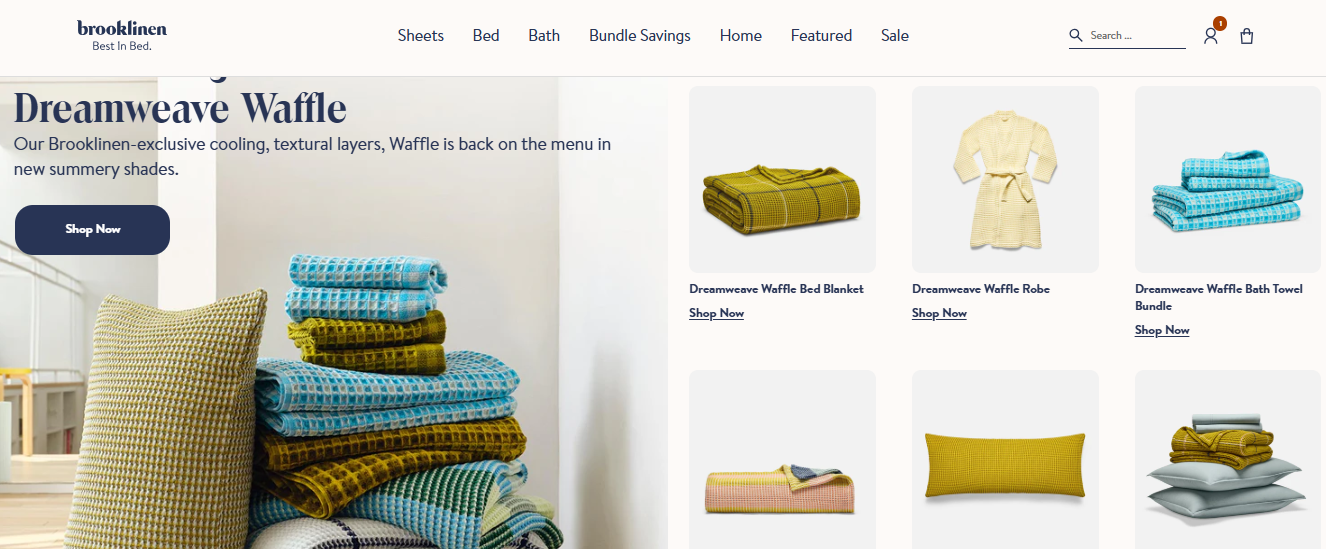
Founded in 2014 by Rich and Vicki Fulop, whose origin story starts with a hotel stay and a price tag that stopped them cold. They launched with one goal:
- Premium quality bedding and towels
- Sold directly to consumers
- No luxury retail markup
Named for Brooklyn, where the brand is based, Brooklinen has grown well beyond sheets. Towels came later, but the same philosophy carried through.
What You Notice Right Out of the Package
The first thing I noticed when I opened the Onsen was the size. It’s longer than a standard bath towel, which is worth mentioning if you’re on the taller side or have just always felt like regular towels don’t quite cover enough.
The waffle texture is flat and open with a clean grid pattern and a thick trim around the edges. It feels more like something you’d find folded on a shelf at a spa than something you grabbed off a big-box store shelf.
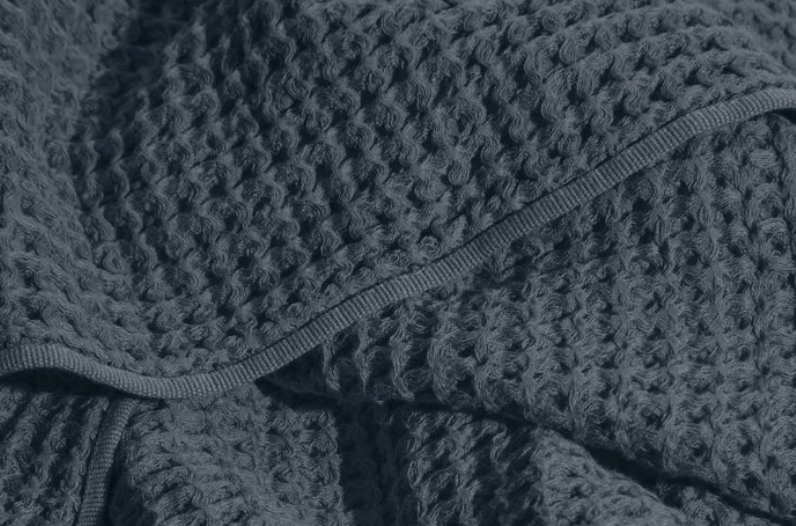
Brooklinen’s Dreamweave Waffle is a little different. The weave is deeper with honeycomb-style pockets, so it has more loft and feels cushier in your hands. It reminded me more of a traditional towel, just lighter.
Both felt genuinely soft out of the package, and I didn’t have a strong preference between the two at that point.
What These Towels Are Actually Made Of
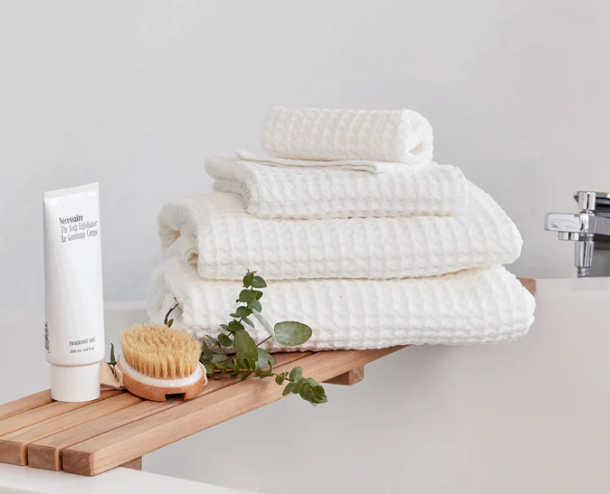
Onsen uses 100% Supima cotton, a US-grown cotton known for having extra-long fibers. Longer fibers mean the yarn ends up finer and stronger, and you can feel that in how lightweight the towel is. It’s noticeably lighter than most towels I’ve used.
The result is a towel, Onsen claims, is up to 45% stronger than standard cotton options and about 30% lighter than the average terry towel. The towel is genuinely light in your hands.
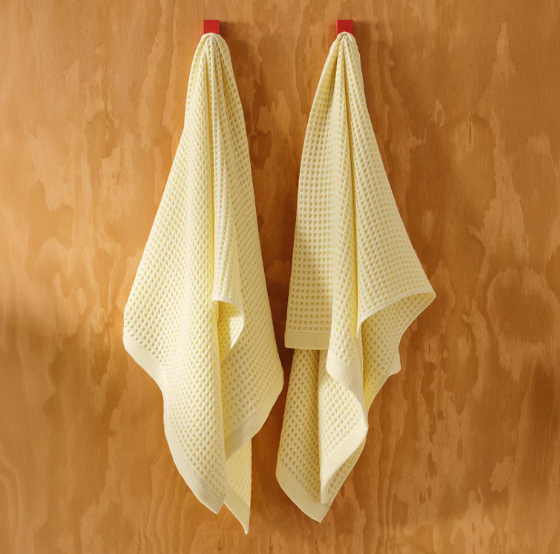
Brooklinen’s Dreamweave is woven from premium Turkish cotton at 290 GSM. Turkish cotton has a solid reputation for absorbency and a softness that tends to get better with washing. At 290 GSM, it sits in a sweet spot, light enough to qualify as a “quick-drying” waffle towel, but with enough density to retain that wrapped-in-comfort feel that terry devotees are used to.
How Each Towel Performs After a Shower
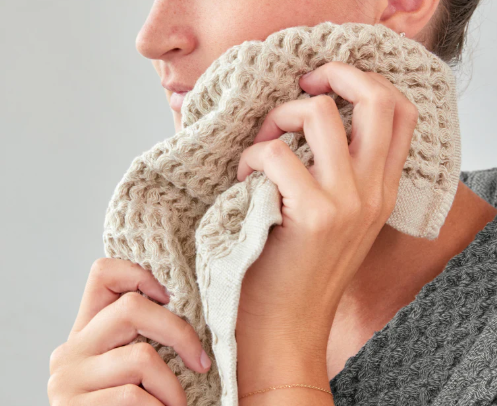
Onsen dries the fastest of the two.
After a shower, it absorbs quickly, and within an hour or so on the towel bar, it feels dry. I never got that musty smell with it, even in a bathroom without great airflow. The flat weave also means it doesn’t shed. With fluffy terry towels, you notice little fibers coming off on your skin and showing up in the dryer lint trap. That’s not something I ran into with Onsen.
Brooklinen takes a little longer to dry, and in a humid bathroom, that’s worth keeping in mind. The tradeoff is that it feels closer to what most people are used to after a shower. The deeper honeycomb structure gives it more of that wrapped-up feeling that terry cloth people tend to miss when they first switch to waffle.
If you’re not sure you’re ready to fully commit to the leaner feel of something like Onsen, Brooklinen is an easier starting point.
Why Onsen’s Hand Towel Stands Out
Real quick: I want to call out the Onsen hand towel specifically because it’s genuinely one of the better hand towels I’ve used in a guest bathroom setting. The waffle weave and the proportions work perfectly for that use, plus it has a loop, which makes it easy to hang.
It looks intentional, dries quickly between uses, and the thick trim around the edge gives it a polished, finished appearance that holds up well on display.
If you’ve been hunting for a hand towel that looks as good as it functions in a guest bathroom, I’d argue that Onsen’s hand towel is a great option.
How Well Each Towel Holds Up After Repeated Washing
Onsen’s Supima cotton is specifically engineered for structural resilience. The extra-long fibers resist fraying and breaking over repeated wash cycles, and the flat weave means it maintains its appearance without pilling or losing shape. Onsen towels also fold down flat, freeing up significant space in linen closets compared to bulky terry options.
Brooklinen specifically redesigned their Dreamweave line to prevent the edge-warping and harsh shrinking that can plague lower-quality waffle weaves. Independent reviewers have noted that it holds its shape and loftiness well over time.
How Each Towel Feels Compared to Regular Terry Cloth
If you’re used to thick, fluffy terry cloth, an Onsen towel will feel thin to you at first.
Though it doesn’t wrap you in the same kind of heavy warmth, some people find that spa-like and refreshing. It’s more absorbent and less “fluffy”, which some people prefer.
Brooklinen lands closer to the middle of the spectrum. It has the quick-dry benefits of a waffle weave without fully abandoning the cozy, substantial feel that makes a towel feel luxurious.
Final Thoughts: Which Towel Is Right for You?
I liked the Brooklinen Dreamweave from the first use. The depth of the weave, the softness, the way it wrapped around you after a shower: it delivered exactly what it promised.
But after a handful of washes, I started noticing the honeycomb pockets, which give the Dreamweave its signature loftiness, began to snag. Small pulls here and there and a rougher texture in spots, a general look of having been used.
Not ruined, not unwearable, but visibly more worn than I expected for a premium towel at that stage of its life. The plushness that made it appealing started working against it, and that deeper structure has more surface area to catch on things, more texture to break down over time.
My Onsen towels were different. They looked, after the same number of washes, essentially the same as when I bought them. Maybe a little broken in, but not snagged. The flat Supima grid stayed intact. No snagging, no pilling, no change in how they hung on the towel bar.
The quality of the cotton showed itself not in that first-use softness but in the staying power. This is what Supima’s extra-long fiber structure actually does in practice: it resists the breakdown that eventually catches up with most towels. The durability claim isn’t just a spec: something you can actually see.
That’s the part that made me want to permanently switch. Both towels start from a strong position. But Onsen holds it.
If you want something that feels immediately luxurious and the cozy, wrapped-in-warmth experience is your priority, Brooklinen Dreamweave earns its place in your bathroom.
It’s a genuinely good towel for the right person. But if you’re someone looking for long-term value and a towel that performs as well on wash twenty as it did on day one and doesn’t ask much of you in return, Onsen is the smarter buy.


