

- The Best Deep Sofas by Use Case - October 5, 2026
- What A Room vs. Room & Board: A Custom Sofa Comparison - September 11, 2026
- Best Custom Sofa Companies: A Buyer’s Guide - August 18, 2026
Do you have a lot of small home projects on your honey do list? And the list keeps growing instead of getting done? Everyone is busy these days, and sometimes you either don’t have the time to tackle them or you just don’t know how. Maybe you’ve used a couple of local handymen before, but they’re never really available when you need them, and you keep having to explain over and over where things are in your home before work can even begin. A handyman membership might be worth it for you. Or maybe you’re more of a one-project-and-done kind of homeowner. In this article, I’m going to break down what a handyman membership actually looks like, whether it’s right for you and your home, or whether you’re better off sticking with a local handyman.
What Is Honey Homes?
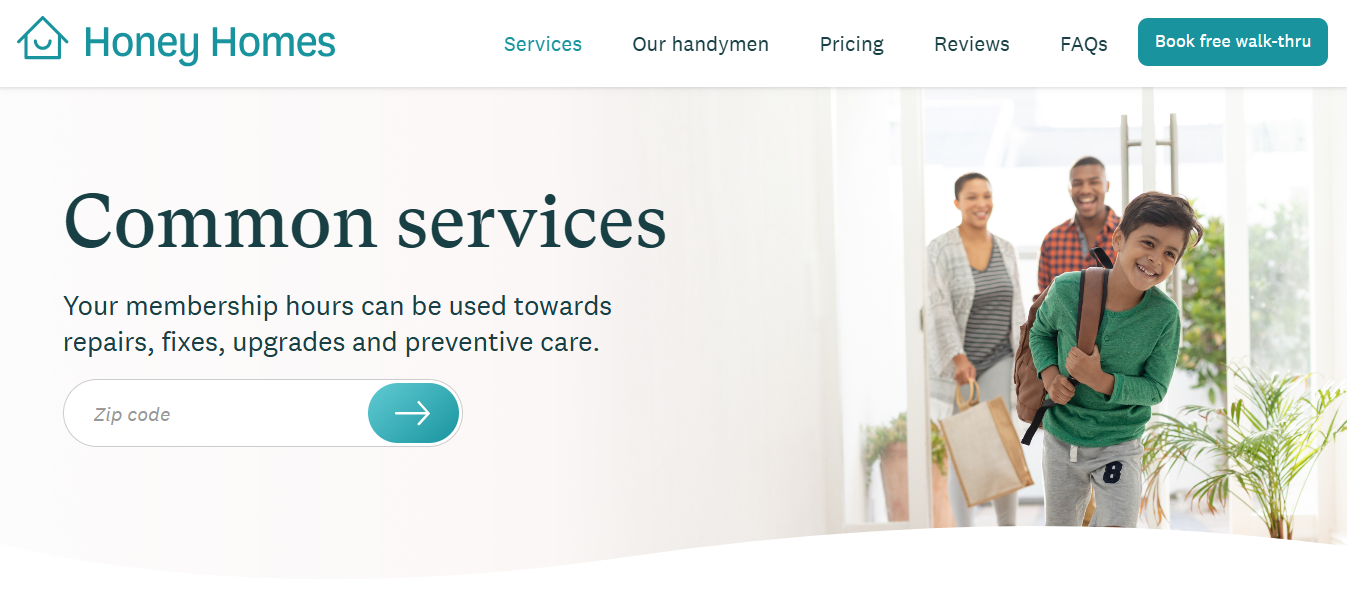
Let’s first break down what this handyman membership actually is. Honey Homes is a home maintenance membership built around one core idea: instead of calling around every time something breaks or needs updating, you get paired with a local dedicated handyman who becomes familiar with your home over time. These aren’t gig workers bouncing between apps. They’re full-time employees of Honey Homes with benefits, and they typically work with a set group of homes/regions. It’s worth noting that their service isn’t yet available everywhere, so check whether your locale is served before going too deep down the comparison.
You book your visits through an app, which also keeps a running task list so you’re not trying to remember what you meant to ask about three weeks ago. You can upload photos and note any supplies you might need to complete a project. Each visit runs about an hour and 45 minutes, and the same person shows up every time, which is a huge plus since you’re not spending half the visit explaining where the water shutoff valve is or where the breaker box lives. That’s especially worth flagging if your handyman charges by the hour instead of by project. Honey Homes also offers a 30-day satisfaction guarantee if something isn’t done right.
Something worth noting: Honey Homes handymen aren’t general contractors, so they won’t be handling major plumbing, electrical work, or anything that requires a permit. They can, however, come in before or after your contractor to prep or finish up drywall or other minor details. So think of it this way: this is general home maintenance and repair. Caulking, drywall patches, hanging shelves, fixing squeaky doors, replacing vents, minor tune-ups, the kind of steady upkeep that never stops needing attention and rarely needs a contractor.
The Membership Tiers
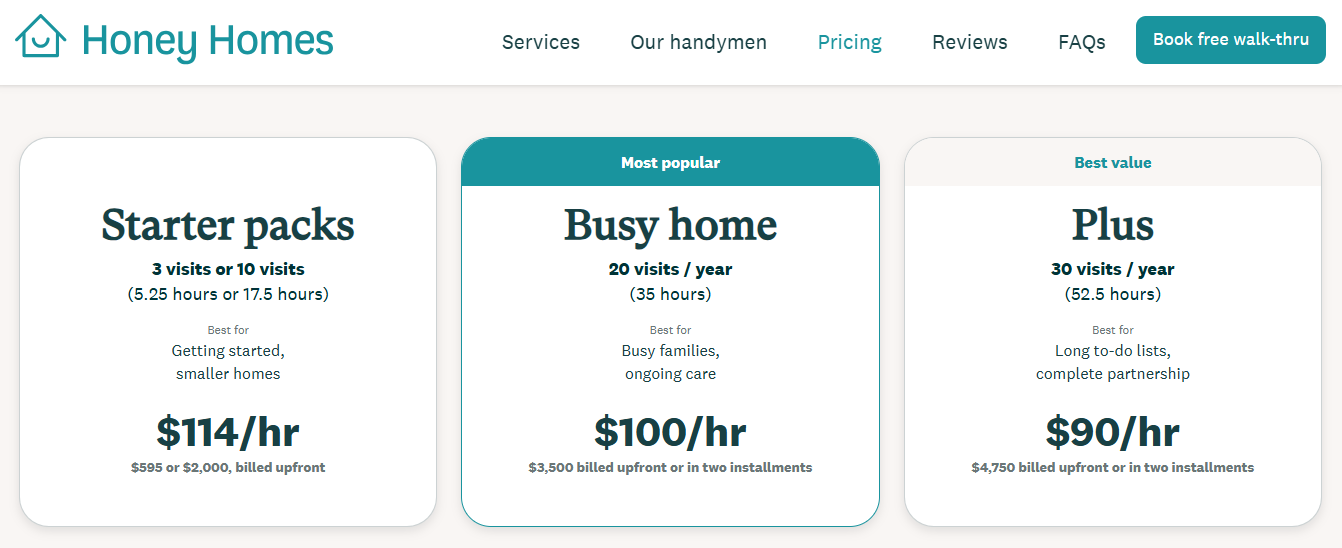
Honey Homes structures its plans around how many visits you need per year, not around square footage or some complicated formula. There are three tiers to choose from.
The Starter tier runs around $2,000 for 10 visits a year. That works out to roughly one visit a month, which usually works for a homeowner with a steady stream of small tasks.
The Busy Homeowner tier sits in the middle at about $3,500 for 20 visits a year, close to two visits a month. This tier is for the person or family who maybe has an older home, a longer list of projects that keep adding up, and just needs someone more frequently.
The Plus plan is the top tier, priced around $4,750 for 30 visits a year, or roughly two and a half visits a month. This tier is for larger properties, multiple ongoing projects, or homeowners who want things handled continuously instead of reaching out only when something bigger comes up.
Pricing and visit counts should be confirmed directly with Honey Homes before you commit. It’s a great question to bring up with the Honey Homes representative who comes out to assess your home initially. What really matters is that you’re not paying per job; you’re paying for consistent access to the same person who already knows your house.
Choosing between the three tiers usually comes down to how long your list is and how quickly you want it handled. If you can go a month between projects without adding to your list, the Starter tier is probably good enough. If you notice things get added to your list faster than you check them off, or you know you’re a busy homeowner and family who will never actually get around to these on your own, the Busy Homeowner tier is the safer bet, since running out of visits halfway through the year and paying for extras defeats the purpose of a predictable annual cost. The Plus tier makes the most sense for larger homes, older properties, or anyone who’d rather have a buffer of visits for ongoing projects than risk being short.
When It Makes Sense

A membership makes sense when you have volume, not when you have a single project. If you’re the kind of homeowner with a list that never seems to shrink, one thing gets fixed and two more get added, that’s exactly what the Honey Homes model was built for.
Older homes are a common example. They tend to generate an endless string of small maintenance needs: a door that starts sticking in humid weather, weatherstripping that wears out, trim that needs recaulking, an outlet cover that cracked last winter, patching up wall cracks, small paint touch-ups. None of these are big jobs on their own, but calling a different handyman for each one gets expensive and things take longer to get finished. It’s also worth considering the energy that goes into scheduling and coordinating multiple jobs with multiple different handymen.
If you’re a busy household with kids, pets, and a full calendar, you’re a strong fit. It’s unlikely you have the bandwidth to research and vet a handful of different handymen, and it’s expensive to have a contractor handle jobs that small anyway. Having one person who already knows your home, its quirks, and your preferences removes a level of stress you may be underestimating.
Rental property owners and people managing multiple units can also benefit from this model, since the value scales with volume. The more properties or ongoing needs you have, the more a flat membership starts to look like a bargain compared to piecing together individual jobs across multiple addresses.
There’s also a category of homeowner who doesn’t quite fit into “old house” or “busy household” but still benefits. Maybe you just moved into a new place. You might’ve inherited a bunch of little things the previous owner left for you to deal with. A dedicated handyman who can work through that list over a few months, instead of you hunting down a new handyman or contractor for each item, can be a great housewarming gift to yourself, a family member, or a friend, one that could make settling into a new place a lot easier.
Honey Homes can also be a good fit if you’re helping an aging parent. A lot of the small repairs that pile up in an older person’s house: loose railings, dripping faucets, things that turn into fall risks or just never get fixed because climbing a ladder isn’t an option anymore. If you live out of state or simply don’t have the bandwidth to handle it yourself, having one dependable person checking in regularly and working through a list can bring real peace of mind, for you and for them.
If you’re getting ready to list your home, a membership can work well there too, especially if you’ve got more than a handful of small repairs to knock out before it goes on the market. Honey Homes can handle chipped paint, loose fixtures, squeaky doors, minor drywall damage. Instead of hiring separate people for each fix, or trying to cram it all into one rushed weekend before your listing goes live, a few visits from the same handyman can work through your whole pre-listing list in a fraction of the time.
When It Doesn’t Make Sense
Now for when this might not make sense for you. If you’ve got one project, maybe a single leaking faucet, a fence that needs a repair, a light fixture that needs swapping, hiring a one-off handyman is likely the better move. It’s hard to justify a membership for a single job. Paying $2,000 for 10 visits doesn’t make sense if you only need one.
The same goes for homeowners who genuinely don’t have much maintenance to do. If you’re in a newer build, everything’s still under warranty, and nothing much has broken or needed updating in the last year or two, a membership is solving a problem you don’t have yet. You’d essentially be prepaying for visits you might not use.
Honey Homes also isn’t the right call for bigger, specialized jobs. Anything involving major plumbing work, electrical rewiring, roofing, or structural repairs falls outside what a general handyman membership is built to handle. You’ll still need to bring in a licensed general contractor for those, membership or not. And if you enjoy doing your own repairs and have the time for it, this is all a bit of a moot point. A membership is for people who want maintenance handled, not for people who want to do it themselves.
How to Compare the Cost: Membership vs. Paying for One-Off Visits

The instinct a lot of people have is to compare the membership price against a single handyman’s hourly rate, and that can be slightly misleading. A better way to think about it is to add up everything on your list, prioritize what you’d like done, and decide whether you want it handled all at once, or you’re fine making multiple separate service calls, vetting individuals, and coordinating schedules along the way yourself.
Independent handyman rates vary a lot by region, but between the service call itself and the labor, individual jobs often add up quickly. If you’re making that call eight, ten, twelve times a year, those totals could come close to the membership pricing. Plus, the cost of your time and stress is worth factoring in too.
The real value isn’t monetary; it’s the consistency and relationship with your handyman. When you hire for one-off jobs, you’re starting from zero every time: explaining your home, negotiating pricing, hoping the person shows up on time, hoping the work is done well. With a membership model, it’s the same person who already knows your home. They remember what type of paint you used in the hallway. They know your dog barks at the doorbell but is harmless. That familiarity saves time on every single visit, and it’s the kind of value that doesn’t show up cleanly on your budget but matters all the same.
Consistency Is the Real Selling Point

If there’s one thing that separates a membership model from calling around for quotes, it’s consistency. Not just in scheduling, but in who’s actually doing the work.
With most other handyman services, you’re taking a chance every time. Different person, different skill level, different communication style. With Honey Homes, you get the same person visit after visit, which means less time spent re-explaining your home and more time getting things actually fixed.
There’s also something to be said for the app-based task list. Instead of keeping a mental (or literal) sticky-note list of things that need attention, you’re logging them somewhere your handyman can see and plan around. Small stuff that would normally get forgotten for months, a cabinet hinge that squeaks, bathroom caulking that’s starting to peel, actually gets addressed instead of living on a list forever. You can also message your handyman directly if something new comes up or you have a question.
Is It Worth It for You?
This all comes down to the size of your list, how often you’d like the work done, and your budget. If you’ve got a running list of small projects that never seems to get shorter, if you value having one person who knows your home instead of a rotating cast of strangers, and if you’d rather pay a predictable annual cost than deal with one-off invoices all year, a membership like Honey Homes is likely to work in your favor.
If you’re dealing with a single project, live in a newer home with little to maintain yet, or need specialized work outside the general handyman purview, you’re better off hiring for that specific job and skipping the membership altogether.
The decision really comes down to how often your house needs attention, and how much you value not having to think about who’s going to fix it every single time.


