


- Signs You Should Switch Your House Cleaning Service - October 14, 2026
- The Best Faucet Mount Water Filters of 2026: Which One Should You Buy? - September 29, 2026
- Best Mattress Topper - September 25, 2026
Both Homeaglow and TIDY let you book a cleaner online without making a phone call, and both will show you pricing before you commit to anything.
I checked them both out for myself when I was trying to find a cleaner for my own home.
I noticed that on the TIDY homepage, you’re greeted with three options: “For Property Managers / Airbnbs,” “For Your Home,” and “For Service Pros.” The fact that property managers come first in that list says a lot about who TIDY is designed for.
Homeaglow, by comparison, offers discounted hourly rates and a browse-and-rebook experience, which feels like it’s built specifically for homeowners who want recurring cleaning at a price that saves money long-term.
So, if you too, have been trying to figure out what to pick between Homeaglow vs TIDY, check out my full breakdown of each platform, including how to decide which one is ultimately right for you.
Homeaglow vs TIDY Compared, At a Glance
| Factor | Homeaglow | TIDY |
| Service type | Platform; browse and book independent cleaners | Platform; book independent cleaners or manage the ones you already work with |
| Pricing structure | $59/mo membership + discounted hourly rates from ~$20/hr | No membership; flat pricing by the hour; one-time cleans cost 25% more than recurring |
| Booking process | Online; browse profiles, choose your cleaner, book, and then discuss details | Online or app; book in ~2 minutes, then build a task checklist for your cleaner |
| Same cleaner each visit | 100% your choice to rebook with the same cleaner or not | Happens automatically; the system will send someone else if yours isn’t available |
| Background checks | Required for all cleaners on the platform | Optional for all cleaners on the platform |
| Satisfaction support | Happiness Guarantee; Homeaglow mediates if you and the cleaner don’t resolve within 72 hours | Defers to each cleaner’s individual satisfaction policy |
| Cancellation | Additional fees if you cancel membership before 6 paid months | Defers to each cleaner’s individual cancellation policy |
| Best for | Recurring home cleaning on a budget | Property managers, Airbnb hosts, or occasional one-time cleans |
What to Expect from Homeaglow and TIDY
The most important thing to understand in this Homeaglow vs TIDY comparison is that both are platforms, which means neither employs cleaners directly. Instead, both can connect you with independent service providers, show you their profiles, and let you book online.
Both platforms cover standard household cleaning, and in both cases, what gets done within your booked time is largely up to you to define.
The Differences
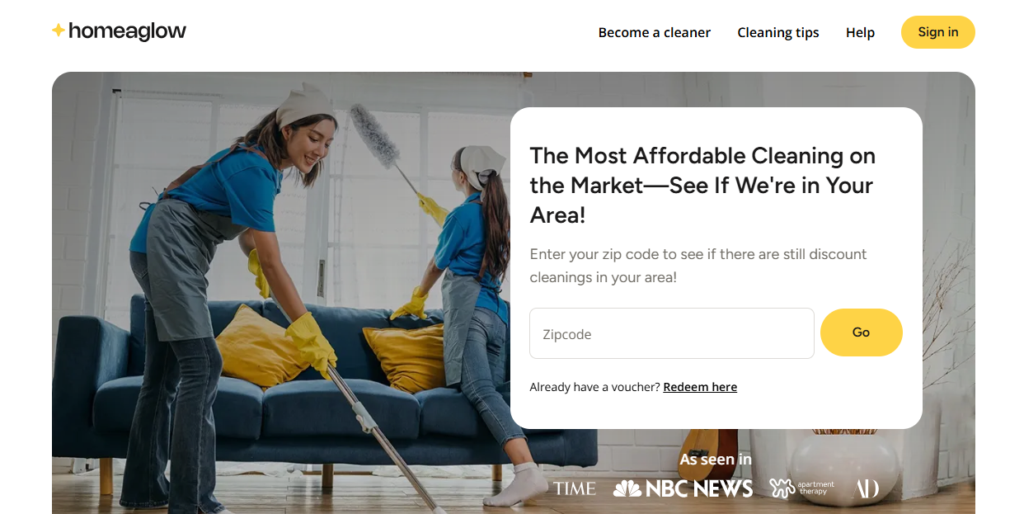
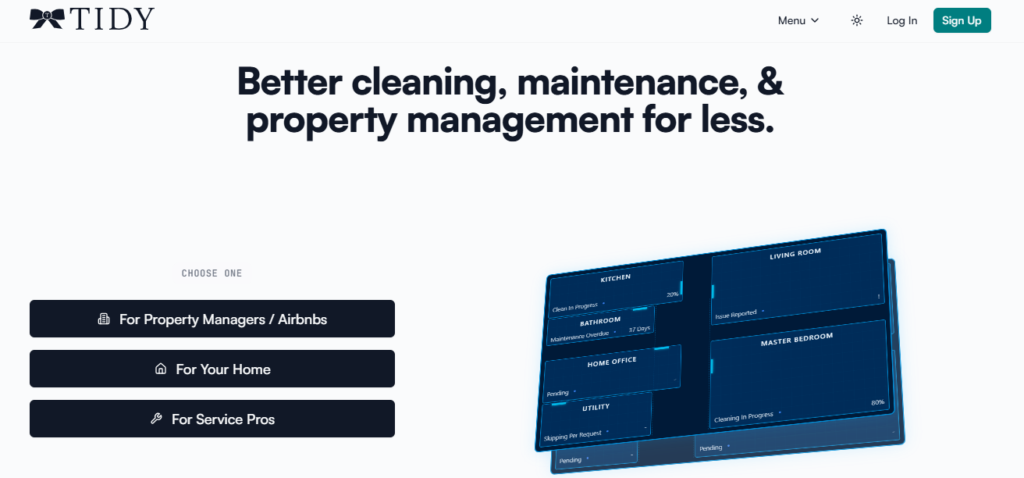
Homeaglow is built around recurring residential cleaning. The whole platform is designed to save homeowners money and simplify our lives.
Basically, you pay a monthly membership fee, which unlocks discounted hourly rates starting at $20/hr. Then, you can rebook the same cleaner visit after visit until they know your home as well as you do. It’s straightforward and very simple.
TIDY, on the other hand, is built around property management at scale. Once you’re inside the dashboard, the design choices make a lot of sense if you’re a property manager.
For example, the main dashboard view is a map of your properties across your city or town rather than a schedule of your upcoming cleans. Then, your cleaning appointments are sorted by property address rather than by date.
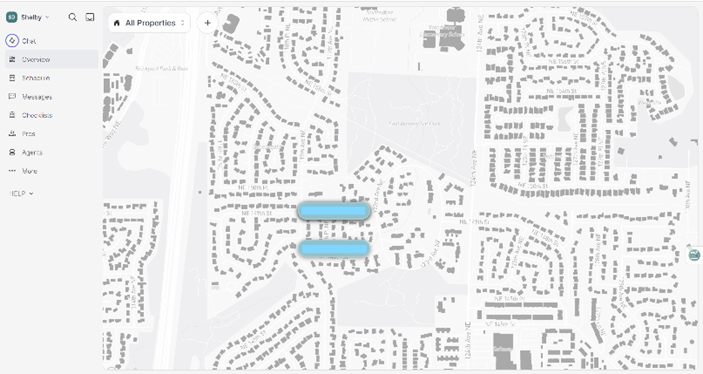
There’s even an entire Agents tab for coordinating multiple service providers, like cleaners, handymen, and pest control, across multiple properties.
If you’re managing a rental portfolio, that’s an incredibly useful infrastructure. But for me, as a homeowner who wants someone to come clean every two weeks, it can feel like navigating software built for something else entirely.
Pricing
Both platforms have a fairly straightforward pricing structure. That said, I once again noticed that TIDY’s pricing worked really well if I had multiple properties, while Homeaglow’s felt more appropriate for cleaning one single property.
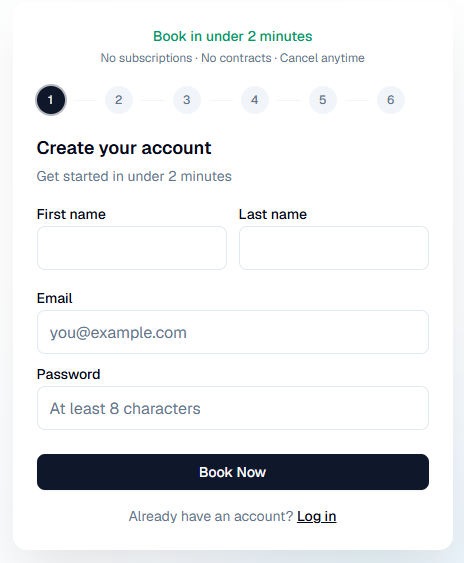
With TIDY, you pay a flat rate based on the amount of time you book, and you can see that pricing before committing to anything. For a four-hour cleaning, which is what I’d need for my four-bedroom home, pricing is listed as:
- Weekly – ~$207
- Every 2 weeks – ~$207
- Every 4 weeks – ~$207
- One time – ~$259
You only pay a higher price if you literally need cleaning one time, and I like how clear that is.
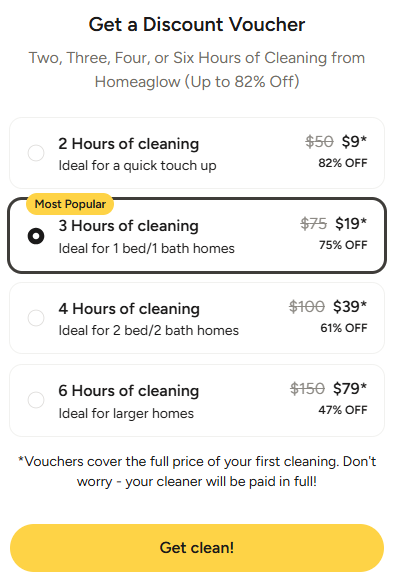
Homeaglow works differently. To get started, you sign up for six months of their ForeverClean membership at ~$59 a month. That membership unlocks discounted hourly rates starting as low as ~$20 per hour. For my home, the pricing breaks down to:
- A four-hour clean at ~$20 an hour is ~$80 per cleaning
- Two biweekly visits a month come to ~$160 in cleaning, plus the ~$59 membership
- That’s around ~$219 a month total, or roughly ~$109 per clean
So, as someone who does want recurring bookings, the gap between these two price points is pretty big. TIDY runs ~$207 per visit for a large home, while Homeaglow works out to about ~$109.
Over six months of biweekly cleaning, that difference adds up to over ~$1,100.
But there’s one more thing to understand clearly before signing up for Homeaglow. Be aware that their new customer offer, which is ~$19 for your first clean, is tied to the ForeverClean membership.
If you cancel before completing six paid months, your first cleaning is charged at full price, which is calculated at ~$35 per hour for however long that first session was. After six paid months, the membership continues month to month, and you can cancel anytime with no penalty.
So, all told, for a one-time or occasional clean of your rental properties, TIDY’s flat-rate model is simpler and avoids any membership commitment entirely.
For regular recurring cleaning, Homeaglow’s per-clean cost is considerably lower once you work through the math.
Booking Experience and Who Each Platform Is Really Built For

Getting your first clean booked on either platform is incredibly fast. TIDY lives up to its “book in two minutes” tagline, since all you have to do is enter your address, pick a time block, add your card, and you’re done.
That said, Homeaglow is just as quick. Within a few minutes, you can browse top-rated cleaners in your area, look through profiles and reviews, choose who you want, see your price, and book.
But after you make that first booking, these platforms have very different user experiences and dashboards.
TIDY’s dashboard is organized around properties, not schedules. If you’re a property manager with multiple Airbnb units, that makes perfect sense, since you can see all your properties on a map, coordinate multiple service providers, and even notify professionals who don’t use TIDY that they’re due at a property.
The digital checklist feature is also very well-designed. You build it once, it carries over from visit to visit, and you can update priorities, add room-specific notes, or swap tasks between visits without being home.
For managing multiple properties at scale, it’s thoughtful, time-saving software.
But for a homeowner with one house who wants someone to come clean on a recurring basis, the TIDY dashboard can feel over-engineered. You’re navigating a platform designed for a property manager when all you really want to see is when your cleaner is coming next.
So, Homeaglow’s experience stays much simpler and cleaner throughout. You simply browse, choose, and then rebook. You can also leave notes for your cleaner directly and communicate with them about priorities, scheduling, or anything you need.
It doesn’t have TIDY’s checklist infrastructure, as you’ll handle that with your cleaner directly, but I personally find it’s much easier to just talk with my cleaner than it is to put together a long checklist in an app.
Cleaner Trust and Consistency

Two things matter a lot when you’re letting someone into your home: whether they’ve been vetted, and whether you’re greeting a new face every single time.
On vetting, there’s a serious difference between these two platforms.
Homeaglow requires all cleaners to pass a background check before joining. It’s not optional, and you can’t be listed as a cleaner on the platform without passing one.
TIDY offers background check certification as an optional badge cleaners can display on their profile, but passing one is not required to list your services on the platform.
And if you want to see only background-checked cleaners on TIDY, you need to manually set that filter before browsing. Miss that step, and you could book someone who hasn’t passed one without realizing it.
Booking Cleaners
With Homeaglow, you choose your cleaner and rebook them directly. That’s entirely within your control, every visit. If your cleaner is unavailable, whether they’re suddenly out sick or let you know far in advance, you talk through it with them and adjust the booking. Or, you always have the freedom to find and book someone else.
TIDY offers what they call Schedule Assurance. In practice, it means their AI automatically schedules your cleaner for recurring visits. If they’re ever unavailable, that same system searches the TIDY network and selects whoever it believes will be a good replacement.
Call me a control freak, but I just don’t love the idea of an AI system deciding which cleaner it’s going to assign to my home, especially since I also have to go out of my way to make sure they’ve passed a background check.
Commitment and Cancellation

This is probably the one single area where TIDY has a potential advantage for homeowners, but it depends on your personal preferences.
TIDY has no membership and, therefore, no early termination fee. Cancellation policies are set by individual cleaners. The most common policy is a 50% charge for cancellations within 24 hours, but there’s no platform-level commitment to exit. If you want to stop working with a cleaner, or stop using TIDY as a whole, you can just stop.
Homeaglow asks for a little more upfront. The ForeverClean membership has a six-month minimum, and canceling before that point means your first cleaning is charged at full price, which typically works out to ~$150–$200.
After six paid months, the membership switches to month-to-month, and you can cancel anytime with no penalty. Individual appointment cancellations are free up to six hours before your booking.
So, the trade-off here is pretty clear. TIDY gives you a bit more flexibility with no financial penalties or fees. Homeaglow asks for a six-month commitment in exchange for a significantly lower per-clean rate.
If you’re not sure recurring cleaning is something you’ll want long-term, TIDY is easier to cancel completely. But if you know you want regular cleaning for the foreseeable future, Homeaglow’s commitment pays off relatively quickly.
My Verdict and Who Each is Best For
The right answer in this Homeaglow vs TIDY comparison ultimately depends on who you are.
If you’re a property manager or Airbnb host managing multiple properties, TIDY is built for your needs in a way that Homeaglow simply isn’t.
The property dashboard, the ability to build AI Agents to handle scheduling logistics, and the multi-provider coordination are all hugely valuable if you’re looking for more than cleaning for your personal residence.
But if you’re a homeowner looking for regular recurring cleaning at the best ongoing value, and you want the guarantee of getting to choose your cleaner and build a rapport over time, Homeaglow is the stronger fit.
The per-clean cost for biweekly service is roughly half of TIDY’s rate, and the functionality of the dashboard is designed around exactly what a homeowner needs, not a property manager.
Think about what your needs are, and you’ll have a pretty clear idea of which platform will make your life easier.

